
By Jennifer Jordan | Charleston Housing News
For much of the past five years, the conversation surrounding housing has been remarkably consistent.
There weren’t enough homes.
Builders couldn’t keep up with demand. Buyers competed fiercely for limited inventory. New construction struggled to satisfy a growing population, and prices climbed to record highs.
Today, that conversation is beginning to change.
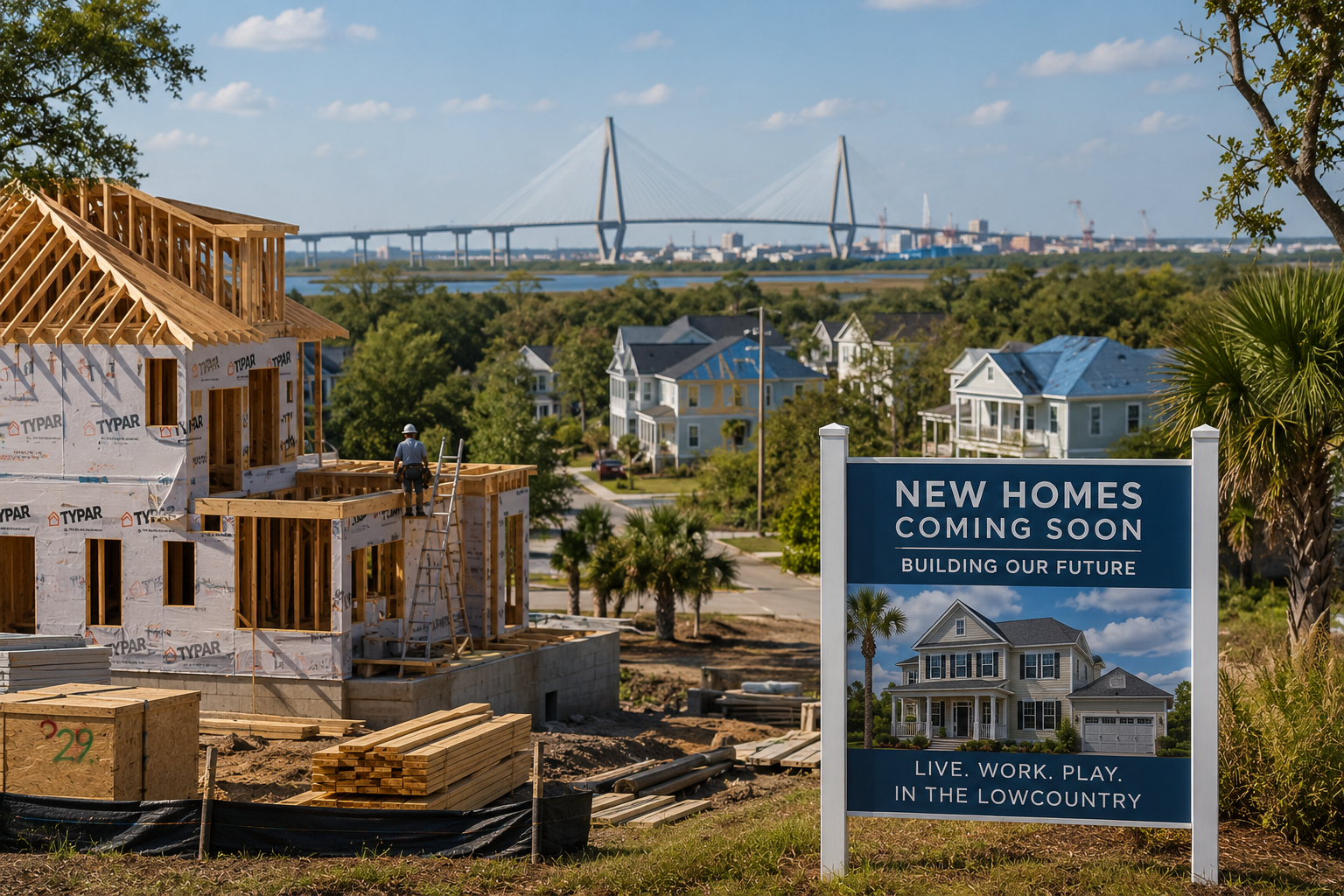
Across the country, homebuilders are becoming more cautious. Construction spending has started to soften, permits are slowing in many markets, and developers are taking a closer look at whether future demand will justify today’s construction costs.
The slowdown doesn’t necessarily signal a housing crash.
It may, however, signal that the housing market is entering a very different phase than the one buyers and sellers experienced after the pandemic.
The National Market Is Beginning to Cool
Recent U.S. Census Bureau data shows overall construction spending has begun flattening after several years of rapid expansion. While total spending remains historically high, year-over-year growth has turned negative, suggesting developers are becoming more selective about which projects move forward.
Industry analysts point to several factors driving the shift.
Higher mortgage rates have reduced affordability.
Construction costs remain elevated.
Financing has become more expensive.
At the same time, buyers have become increasingly selective, causing some builders to slow future projects until market conditions become clearer.
Rather than indicating an economic collapse, many economists describe the trend as a normalization after an unprecedented building cycle.
Charleston Is Seeing a Different Story
Charleston remains one of the fastest-growing metropolitan areas in the Southeast, but that doesn’t mean every segment of the market is equally strong.
In fact, the region is beginning to experience something many local buyers haven’t seen in years.
Choice.
Thousands of apartment units have recently been completed across the Charleston area, with thousands more currently under construction. New master-planned communities continue expanding throughout Berkeley and Dorchester counties, while redevelopment projects are adding additional housing closer to downtown.
That increase in supply is giving buyers more options.
More options almost always lead to more competition among sellers.
Builders Are Becoming More Strategic
During the height of the post-pandemic housing boom, builders could often release homes with confidence that buyers would quickly absorb new inventory.
Today’s market requires a different approach.
Developers are paying closer attention to location, buyer demographics, financing conditions, and pricing before breaking ground.
Projects with strong long-term fundamentals continue moving forward.
Marginal projects are facing greater scrutiny.
That’s not necessarily bad news.
More disciplined construction can help reduce the risk of creating significant oversupply in individual markets.
Buyers Are Taking Their Time Again
One noticeable difference throughout Charleston is buyer behavior.
Consumers no longer feel the same urgency they experienced just a few years ago.
Instead of writing offers immediately, many are comparing neighborhoods, negotiating price, evaluating floor plans, and carefully considering future insurance costs, property taxes, HOA fees, and commuting times.
That slower decision-making process naturally affects builders as well.
When sales slow, construction schedules often follow.
The Labor Challenge Hasn’t Gone Away
Even as construction activity moderates, the industry faces another long-term challenge.
Finding skilled workers.
Many experienced tradespeople have retired over the past several years, while fewer younger workers have entered construction careers.
That means even if housing demand accelerates again, labor shortages could continue limiting how quickly builders can respond.
It’s one reason many economists believe future housing shortages could reappear if construction slows too aggressively today.
What This Means for Charleston Homeowners
For homeowners, the national construction slowdown should be viewed as context rather than a prediction.
Charleston’s housing market has always behaved differently than many parts of the country because of its steady population growth, desirable lifestyle, expanding employment base, and limited supply in many established communities.
That said, sellers should recognize that buyers have become considerably more discerning.
Homes that are well maintained, thoughtfully updated, properly priced, and professionally marketed continue attracting strong interest.
Homes with deferred maintenance, dated floor plans, or unrealistic pricing are taking longer to sell than they would have only a year ago.
The Bigger Picture
Housing markets rarely move in straight lines.
They expand.
They pause.
They rebalance.
Today’s construction slowdown appears to reflect that rebalancing process rather than the beginning of a major downturn.
For Charleston, the question isn’t whether construction is slowing nationally.
The question is whether the region can continue adding the right housing, in the right locations, at prices local residents can actually afford.
As population growth continues and affordability remains one of the Lowcountry’s biggest challenges, the success of Charleston’s housing market won’t simply be measured by how many homes are built.
It will be measured by whether the homes being built match the needs of the people who want to call Charleston home.
Leave a Reply