
By Jennifer Jordan | Charleston Housing News
Zoning maps rarely generate headlines.
But when they have the potential to change what property can be used for—and what it’s may be worth—they quickly become one of the most important real estate conversations in town.
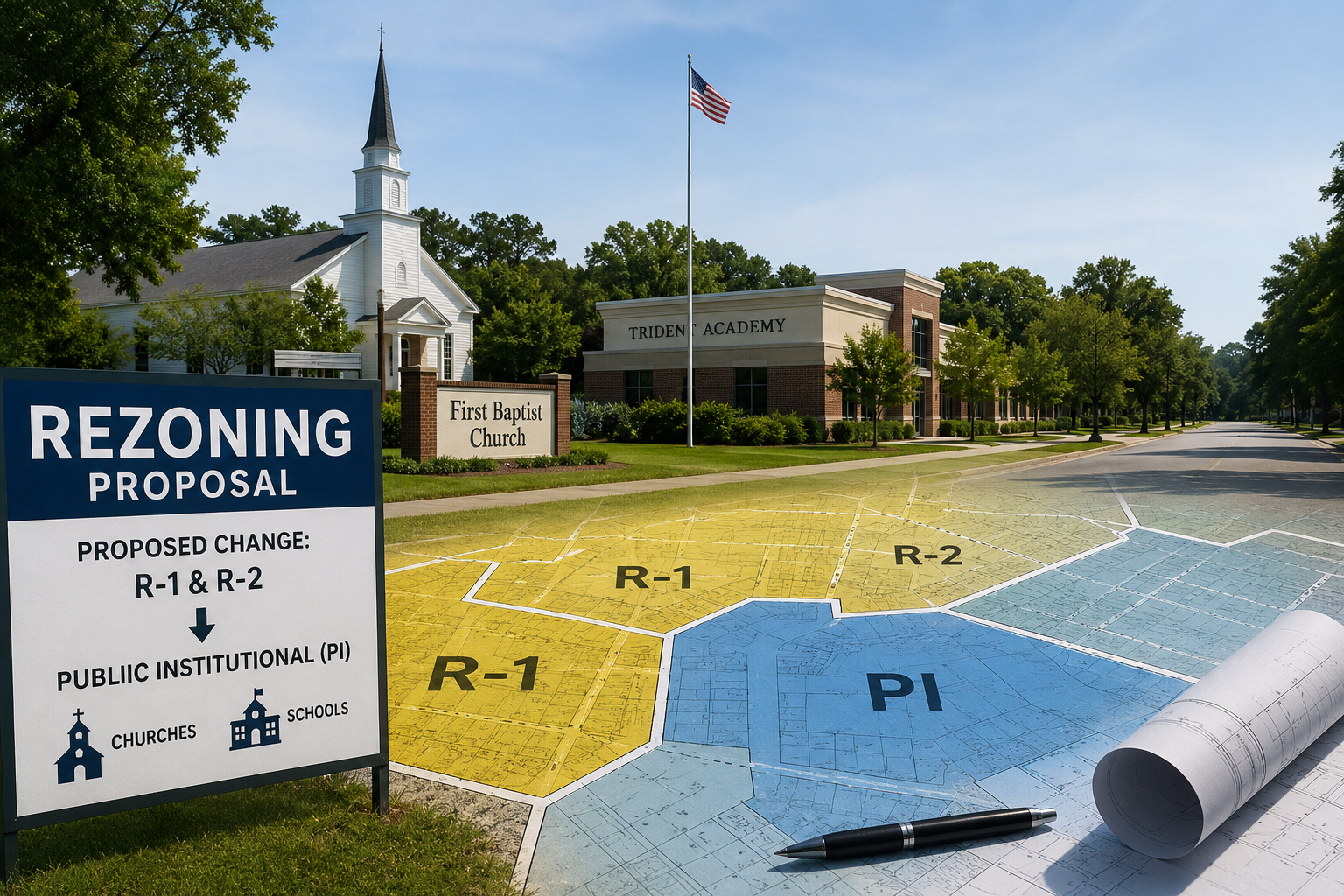
That’s exactly what is unfolding in Mount Pleasant as town leaders continue discussing whether dozens of churches and schools should be rezoned from residential classifications to a new Public Institutional (PI) designation.
While supporters say the proposal is intended to preserve institutional properties and prevent future residential redevelopment, some property owners worry the unintended consequence could be a significant reduction in property values and financial flexibility.
No organization expressed those concerns more directly than Trident Academy during a recent Planning Committee meeting.
More Than a School
For most residents, Trident Academy is simply a longtime Mount Pleasant school.
For thousands of Lowcountry families, it’s much more.
The school has spent more than five decades serving students with learning differences, helping children who often struggled in traditional classrooms find confidence and academic success.
According to school leadership, more than 2,000 families have benefited from its programs over the past 55 years.
Today, however, the school finds itself facing a different kind of challenge.
A Financial Recovery Could Be Impacted
Representatives from Trident Academy told town officials that the proposed rezoning could dramatically affect the value of land the school hopes to sell as part of its long-term financial recovery.
Board Chairman JC Taylor explained that after selling the campus during the economic uncertainty surrounding the COVID-19 pandemic, the school has been working toward eventually repurchasing its property.
Part of that strategy includes selling adjacent land to generate the capital necessary to strengthen its financial position.
Taylor argued that changing the property’s zoning designation could reduce its market value by millions of dollars, making that recovery substantially more difficult.
His concern extends beyond Trident Academy.
He noted that numerous churches and schools appearing on the town’s rezoning list could face similar financial consequences.
Protecting Institutions or Limiting Their Options?
The proposal highlights an increasingly common planning challenge facing rapidly growing communities.
Mount Pleasant wants to preserve schools, churches, and other institutional uses that contribute to the community’s identity.
Town leaders have expressed concern that institutional properties could eventually be sold for higher-density residential development if existing zoning remains unchanged.
From a planning perspective, that objective is understandable.
Yet property owners argue that permanently reducing redevelopment potential may also reduce the underlying value of their land.
Those competing priorities often collide whenever zoning changes are proposed.
Property Rights and Community Planning
Zoning has always represented a balance between private property rights and community planning.
Communities routinely regulate how land may be used to protect surrounding neighborhoods, preserve infrastructure capacity, and encourage orderly growth.
At the same time, zoning decisions can have real financial consequences for property owners.
Changing what may legally be built—or limiting future redevelopment opportunities—can affect both current market value and future investment potential.
Whether the proposed Public Institutional designation would significantly impact individual properties remains a matter of debate.
What is clear is that many affected organizations want a more thorough evaluation before permanent decisions are made.
One Size May Not Fit Every Property
During previous Town Council discussions, several elected officials questioned whether all 163 institutional properties should be treated identically.
Some suggested conducting property-by-property evaluations rather than applying a broad zoning change across every school and church.
That approach could allow the town to better understand each property’s history, surrounding development, and long-term community role before making permanent zoning decisions.
For organizations like Trident Academy, those distinctions matter.
Their future financial plans may depend upon them.
Why This Matters Beyond Schools
Although the immediate discussion centers on churches and educational institutions, the conversation raises broader questions about how zoning influences real estate values throughout Mount Pleasant.
Buyers, developers, investors, nonprofit organizations, and lenders all consider zoning when evaluating property.
Future development rights often become part of a property’s overall value.
When those rights change, valuations can change as well.
That’s why rezonings frequently become some of the most closely watched decisions local governments make.
The Bigger Picture
Mount Pleasant continues facing tremendous growth pressure.
Residents consistently express support for protecting community character while limiting unnecessary density.
At the same time, schools, churches, and nonprofit organizations often rely upon the flexibility of their real estate assets to adapt to changing financial circumstances.
Finding the right balance between preserving institutional uses and preserving property value will not be easy.
The discussion surrounding Trident Academy demonstrates that land-use decisions rarely affect only future development.
Sometimes, they shape the financial future of the institutions that have served the community for generations.
As Mount Pleasant continues reviewing the proposal, the conversation has grown beyond zoning classifications.
It has become a debate about property rights, financial stewardship, educational investment, and how communities preserve both their character and the organizations that helped build it.
Leave a Reply