
By Jennifer Jordan | Charleston Housing News
For years, Charleston-area real estate operated as though prices could only move in one direction.
Up.
Fueled by pandemic migration, ultra-low mortgage rates, remote work, lifestyle demand, and massive inflows of outside wealth, home values across Charleston, Mount Pleasant, Summerville, Daniel Island, Johns Island, and much of the Lowcountry surged at historic speeds between 2020 and early 2022.
But nationally, the housing market is changing.
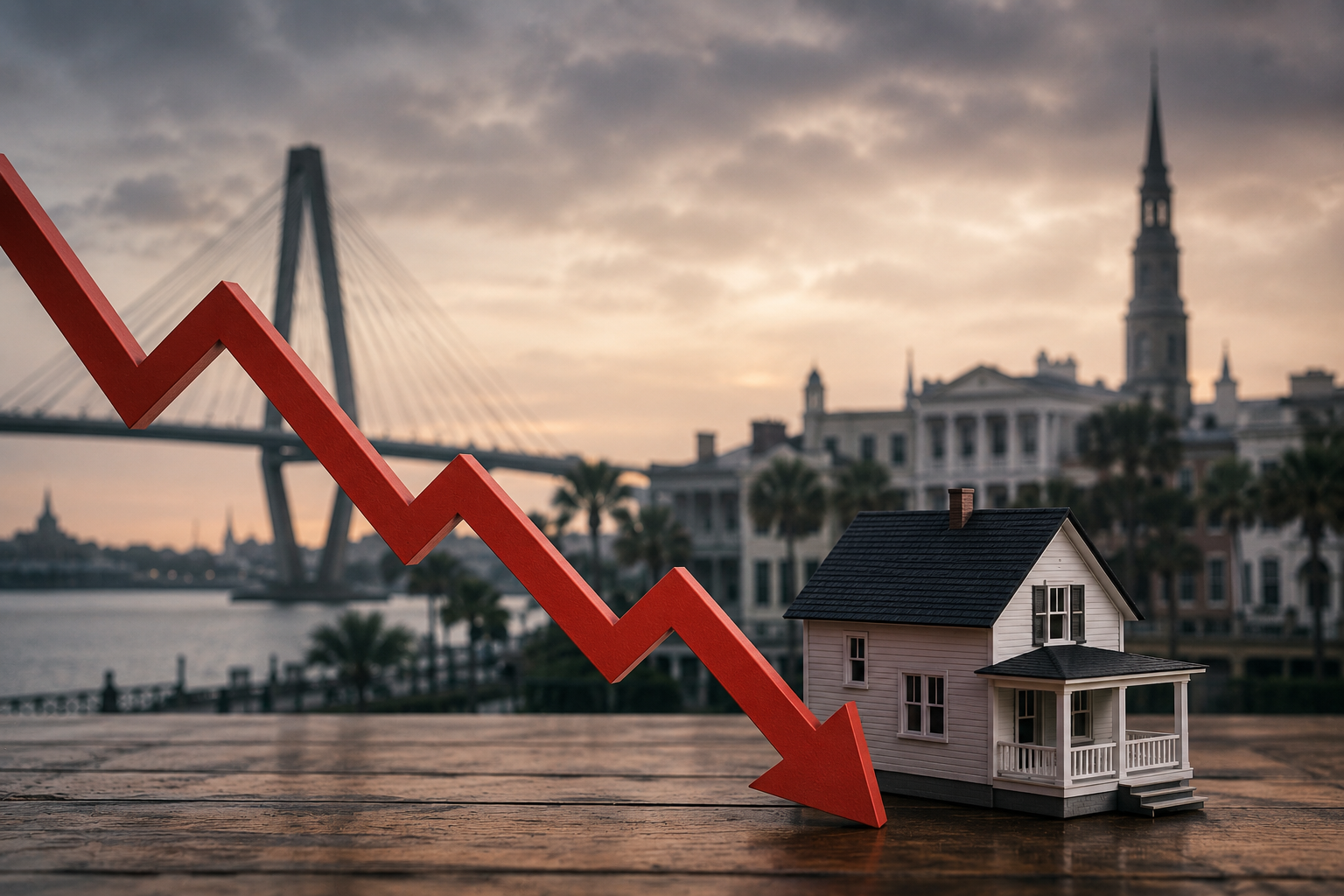
A growing number of metropolitan areas across the United States are now experiencing measurable home price declines, with reports showing more than 80 housing markets beginning to soften or move into negative year-over-year territory.
Charleston is not collapsing like some overheated western or Sunbelt markets.
But for the first time in years, the Lowcountry is beginning to show subtle early signs of housing weakness — and many local leaders, homeowners, and sellers may not fully appreciate what that could mean if current trends continue.
Charleston’s Market Is No Longer Operating in a Frenzy
The most important shift happening right now is psychological.
For years, buyers believed:
- prices would keep rising,
- inventory would stay tight,
- homes would sell instantly,
- and waiting meant paying more later.
That mindset created enormous urgency throughout the Charleston market.
Today, that urgency is fading.
Across many parts of the region:
- homes are sitting longer,
- price reductions are increasing,
- buyers are negotiating harder,
- inventory is growing,
- and sellers are losing some pricing power.
Even if prices are only softening modestly in Charleston compared to national declines, the direction matters.
Because housing markets are heavily driven by momentum and confidence.
Mount Pleasant, Charleston and Summerville Are Feeling It Differently
Not all Charleston-area submarkets are behaving the same way.
Higher-end areas like:
- South Mount Pleasant,
- Old Village,
- Isle of Palms,
- Sullivan’s Island,
- downtown Charleston,
- and portions of Daniel Island
continue benefiting from wealth-driven demand and limited inventory.
But even many luxury buyers are becoming more cautious as:
- mortgage rates remain elevated,
- stock market volatility increases,
- insurance costs climb,
- and economic uncertainty grows.
Meanwhile, outer suburban growth corridors are showing more visible pressure.
In areas like:
- Summerville,
- Cane Bay,
- Goose Creek,
- Moncks Corner,
- Ladson,
- and portions of North Charleston,
buyers are becoming dramatically more payment-sensitive than they were during the pandemic boom years.
Builders are increasingly offering:
- rate buydowns,
- closing cost assistance,
- upgrades,
- appliance packages,
- and incentive-heavy financing deals
to maintain absorption pace.
That alone signals a fundamentally different market environment than what existed two years ago.
Charleston’s Affordability Problem Is Starting to Hit Demand
The reality is simple:
Charleston has become extraordinarily expensive relative to local incomes.
Between:
- mortgage rates near 7%,
- sharply higher insurance premiums,
- rising property taxes,
- HOA increases,
- and elevated home prices,
many buyers are simply reaching affordability exhaustion.
That does not mean people no longer want to live here.
They absolutely do.
But desire and affordability are two very different things.
The problem for many buyers today is not willingness.
It is monthly payment reality.
The “Lock-In Effect” Is Distorting the Market
Another major issue quietly affecting Charleston is the mortgage “lock-in effect.”
Thousands of local homeowners secured mortgage rates between roughly 2.5% and 4% during the pandemic years. Many now refuse to move because replacing those loans at today’s rates would dramatically increase monthly costs.
That creates a strange market dynamic:
- fewer people listing homes,
- fewer move-up buyers,
- lower transaction volume,
- and a market that feels simultaneously tight and sluggish.
It also means inventory growth is happening unevenly, often concentrated in new construction and investment-heavy corridors.
The Bigger Risk: Charleston May Be Entering a Flat Market
The larger concern may not be a dramatic crash.
It may be stagnation.
A market where:
- appreciation slows substantially,
- inflation outpaces housing gains,
- ownership costs continue rising,
- and homeowners no longer build wealth at the pace they expected.
That type of environment can be surprisingly damaging psychologically because many buyers and investors purchased under assumptions shaped by the extraordinary pandemic housing cycle.
But those years were not normal.
Historically, real estate markets move in cycles.
Charleston is not exempt from economic gravity forever.
Why This Matters for Homeowners
Many homeowners still believe Charleston’s desirability alone guarantees permanent appreciation.
Long term, Charleston likely remains one of the Southeast’s stronger housing markets because of:
- coastal lifestyle appeal,
- retirement migration,
- limited waterfront geography,
- tourism,
- and wealth inflows.
But short-term and medium-term pricing pressure absolutely can occur even in highly desirable markets.
Especially when affordability breaks down.
That is why even modest price declines or flat pricing trends should not be ignored.
They are often early indicators of broader market normalization — or weakening demand underneath the surface.
The Bottom Line
Charleston’s housing market is not imploding.
But it is clearly transitioning away from the extraordinary conditions that drove prices relentlessly upward during the pandemic boom.
With more than 80 U.S. housing markets now seeing measurable value declines, Charleston’s early signs of softening deserve attention — particularly as affordability pressure, rising ownership costs, and slower buyer activity continue building across the Lowcountry.
The real danger may not be a crash.
It may be a prolonged period where Charleston homeowners slowly realize the era of easy appreciation is over.
Leave a Reply