
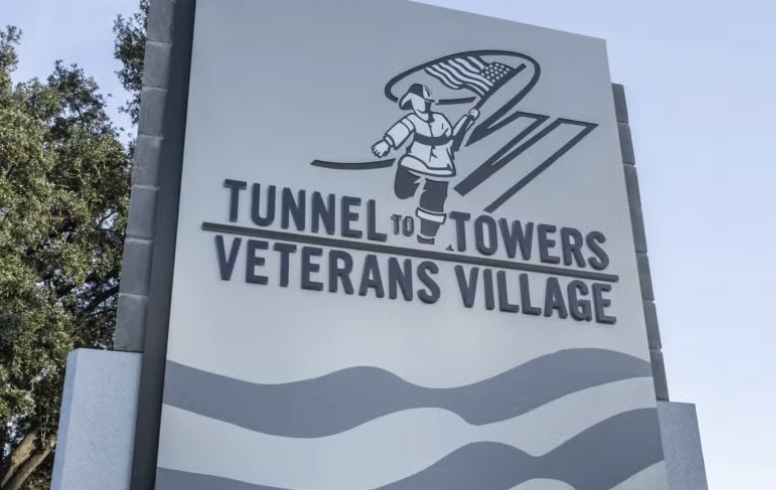
Tunnel to Towers transforms former hotel into permanent homes for veterans seeking stability, community and a path forward.
By Jennifer Jordan | Charleston Housing News
For many veterans, the hardest battle doesn’t begin on the battlefield.
It begins after the uniform comes off.
Finding affordable housing, managing medical expenses, rebuilding careers and reconnecting with a community can become overwhelming challenges for those who have already sacrificed in service to their country.
This week, North Charleston took an important step toward addressing that reality.
The Tunnel to Towers Foundation officially opened Veterans Village, a 91-unit affordable housing community created by converting a former hotel on Ashley Phosphate Road into permanent housing designed specifically for veterans.
The first residents have already moved in.
Their arrival represents far more than the opening of another apartment complex.
It represents a growing recognition that housing stability is often the foundation upon which veterans can rebuild the next chapter of their lives.
Housing Is Often the First Step Toward Recovery
One of the first residents, Army veteran Mark Delbrook, spent ten years serving his country before receiving a thyroid cancer diagnosis that left him facing significant medical debt.
Although disability benefits helped, rising housing costs and financial obligations made it increasingly difficult to move forward.
Now, with affordable housing and predictable monthly expenses, he says he can finally begin saving toward one of his long-term goals—homeownership.
His story is hardly unique.
Across South Carolina and much of the nation, veterans often find themselves caught between rising housing costs and fixed or limited incomes. Stable housing can become the difference between simply surviving and beginning to plan for the future again.
More Than an Apartment
Unlike many affordable housing developments, Veterans Village was intentionally designed to provide more than a roof overhead.
Each fully furnished studio apartment includes a private bathroom, kitchenette, refrigerator, cooktop, microwave and television. Accessible units are available for veterans with mobility challenges.
The property also includes shared amenities that encourage both independence and community, including:
- A fitness center
- Laundry facilities
- Computer room
- Community lounge
- Professional clothing closet
- Recreation areas
Perhaps more importantly, residents have access to wraparound support services including behavioral health professionals, employment counseling, housing coordinators and case management.
The nonprofit also plans to partner with local organizations to offer financial literacy education, cooking classes and wellness programs.
Those services recognize an important truth.
Affordable housing alone rarely solves housing insecurity.
Long-term success often requires support systems that help residents regain financial independence and stability.
An Innovative Use for Aging Hotels
Veterans Village also highlights a broader trend beginning to emerge across the Charleston region.
Rather than allowing aging hotels to remain vacant or deteriorate, developers and nonprofit organizations are increasingly repurposing these properties into housing.
From a planning perspective, adaptive reuse often makes economic sense.
Existing infrastructure is already in place.
Construction timelines are typically shorter than building from the ground up.
Communities benefit by reducing blighted commercial properties while creating much-needed housing.
North Charleston is already seeing additional examples of this approach, with another former hotel slated for conversion into income-restricted housing through public-private partnerships.
As housing affordability continues to challenge communities across the Lowcountry, adaptive reuse may become an increasingly valuable tool.
The Housing Challenge Hasn’t Disappeared
North Charleston remains one of the more affordable housing markets in the Charleston region, but affordability has become increasingly relative.
Over the past five years, home prices have risen substantially while rents have climbed even faster.
For many working households—and particularly veterans living on disability or fixed retirement income—finding quality housing without becoming financially burdened has become increasingly difficult.
Housing experts generally consider a household “cost burdened” when more than 30 percent of monthly income goes toward housing expenses. Thousands of households across the Charleston region continue to exceed that threshold.
Projects like Veterans Village won’t solve the broader affordability shortage on their own.
But they demonstrate how targeted partnerships between nonprofits, local governments and private organizations can help address specific community needs.
A Model Worth Watching
Charleston’s rapid population growth has placed tremendous pressure on housing affordability across nearly every income level.
The challenge requires more than one solution.
New construction.
Redevelopment.
Workforce housing.
Senior housing.
Veteran housing.
Each serves a different population facing unique challenges.
Veterans Village is an example of what can happen when existing buildings are thoughtfully repurposed to serve a larger mission.
For the veterans receiving keys this week, the project isn’t simply about affordable rent.
It’s about restoring stability.
Creating community.
And providing a foundation from which they can once again build their futures.
Sometimes the most important housing developments aren’t measured by luxury finishes or record-breaking sales prices.
They’re measured by the lives they help rebuild.
Leave a Reply