
by Jennifer Jordan
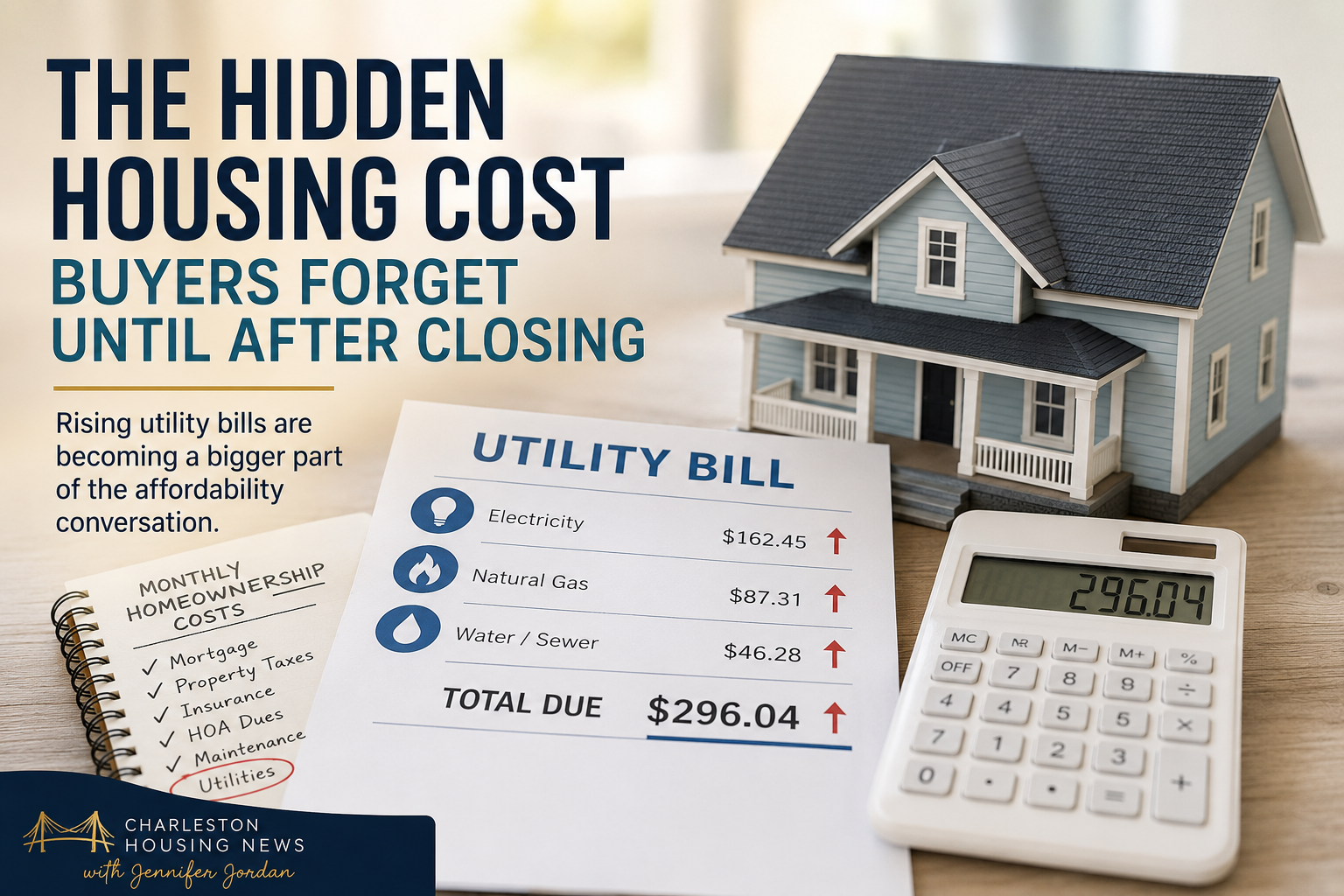
Rising utility bills are becoming a bigger part of the affordability conversation.
By Jennifer Jordan | Charleston Housing News
For years, the national housing conversation has centered on one number: mortgage rates.
Every time the Federal Reserve meets, every jobs report is released, or inflation data comes in, prospective buyers immediately ask the same question:
“Will mortgage rates finally come down?”
It’s an understandable obsession. Mortgage payments remain the single largest monthly expense for most homeowners.
But there is another housing cost quietly climbing in the background that receives far less attention—and unlike a mortgage, there’s almost nothing homeowners can do to control it once they move in.
Utility bills.
The Costs That Never Stay Fixed
Mortgage rates eventually change.
A homeowner who purchases at 7% may refinance at 5.5% several years later if rates fall. Property taxes can sometimes be appealed. Insurance policies can be shopped.
Electricity, natural gas, water and sewer bills don’t work that way.
They fluctuate with utility rate increases, fuel prices, infrastructure upgrades, seasonal demand and decisions made by utility providers and regulators. Homeowners simply receive the bill each month.
Recent national data illustrates the trend.
Residential electricity prices have increased roughly 4% over the past year, while residential natural gas costs are also moving higher. Even as broader energy markets have softened at times, many homeowners have continued seeing larger monthly utility bills.
That disconnect matters because families don’t budget based on wholesale energy markets.
They budget based on what arrives in the mailbox.
Charleston Buyers Are Feeling It
In the Charleston region, utility costs vary dramatically depending on where a buyer chooses to live.
A newer home in Nexton, Carolina Park or Point Hope with modern insulation, energy-efficient windows and high-efficiency HVAC equipment may cost significantly less to operate than an older home of similar size built decades earlier.
Likewise, two homes selling for exactly the same price can produce very different monthly budgets.
One may have aging HVAC equipment, original windows and minimal attic insulation.
The other may include upgraded insulation, energy-efficient appliances, LED lighting and smart thermostats.
The mortgage payment may be identical.
The utility bills may not.
Affordability Is More Than the Purchase Price
Too often, buyers calculate affordability using only four numbers:
- Purchase price
- Down payment
- Interest rate
- Property taxes
Those are certainly important, but they’re only part of the equation.
Monthly ownership also includes insurance premiums, HOA dues, maintenance, flood insurance in many Lowcountry neighborhoods—and increasingly, utility expenses.
For many households, an additional $150 to $250 each month in operating costs can influence how comfortably they live just as much as a slightly higher mortgage payment.
Charleston’s Climate Adds Another Layer
Unlike many parts of the country, Charleston homeowners battle long cooling seasons.
Air conditioning isn’t simply a luxury from June through September.
It’s often necessary from spring through early fall, with humidity frequently driving cooling costs even higher.
Older HVAC systems, poorly insulated attics and aging ductwork can quietly add hundreds—or even thousands—of dollars annually to the cost of owning a home.
That’s why experienced inspectors increasingly recommend buyers pay close attention not only to the condition of a roof or foundation but also to the home’s energy performance.
Sellers Can Benefit Too
Energy efficiency isn’t just a buyer concern.
It’s becoming a selling advantage.
Simple improvements like additional attic insulation, HVAC servicing, duct sealing, programmable thermostats and energy-efficient lighting may not generate dramatic headlines, but they can improve buyer confidence and reduce objections during negotiations.
In a market where buyers are watching every monthly expense, lower operating costs can become another reason a home stands out from competing listings.
The Monthly Payment Isn’t the Whole Story
Mortgage rates will likely remain the headline issue for housing markets nationwide.
But homeowners don’t live inside interest rates.
They live inside monthly budgets.
The total cost of homeownership includes every recurring expense required to keep the lights on, the air conditioning running and the household functioning.
As Charleston continues to grow—and as utility providers invest in expanding infrastructure to serve that growth—buyers would be wise to look beyond the mortgage calculator.
The purchase price gets you into the home.
The monthly operating costs determine how affordable it really is.
Leave a Reply