
By Jennifer Jordan | Charleston Housing News
Another major expansion is moving through Berkeley County’s approval process, and once again it is placing Cane Bay at the center of one of the Lowcountry’s most contentious growth debates.
The proposed Lake Village development would add approximately 5,500 new homes, commercial space, parks and additional infrastructure on roughly 2,000 acres bordering the existing Cane Bay community. While the developer says the project represents a more thoughtful, lower-density plan than previous entitlements allowed, many nearby residents argue the proposal simply adds another massive subdivision to an area already struggling with traffic congestion, stormwater concerns and strained infrastructure.
County Council is expected to consider the proposal through a series of public meetings over the coming months before making a final decision.
A Rural Area Continues to Urbanize
The project would be located between the established Cane Bay communities and U.S. Highway 17A, adjacent to longtime neighborhoods including Lakewood, Windwood and Whitesville.
Unlike the master-planned subdivisions surrounding them, these communities developed over decades as rural homesteads featuring larger lots, modest homes, wooded properties and narrow two-lane roads.
Residents say they moved there specifically because of the area’s quieter, lower-density character.
Many now fear another large-scale development will permanently alter that lifestyle.
Developer Says Plan Reduces Density
Representatives for Gramling Brothers Real Estate & Development argue the proposal should not be viewed simply as another subdivision.
According to the developer, portions of the property already fall within existing development agreements that could permit greater residential density. They describe the current proposal as effectively reducing the number of homes previously allowed while creating a more balanced master-planned community.
Plans include:
- Approximately 5,500 residential homes
- Retail and commercial space
- Public parks and greenways
- Waterfront restaurants and shops surrounding a large central lake
- Land donations for future schools and emergency services
- Significant preserved open space and lakes
- Impact fees dedicated toward schools and public safety
Developers also say nearly half of the property would remain as lakes, preserved open space and recreational areas.
Traffic Remains the Largest Concern
Despite those commitments, transportation remains the dominant issue for many residents.
Anyone traveling Highway 17A during peak hours understands why.
Traffic volumes throughout Cane Bay have increased dramatically over the past decade as thousands of homes have been constructed across multiple phases of development.
Residents worry another 5,500 homes could further burden already congested roadways unless significant transportation improvements occur before additional residents arrive.
The developer has proposed contributing $10 million toward roadway improvements and constructing multiple roadway connections to Highway 17A intended to distribute traffic more efficiently.
Traffic studies submitted with the application are currently under review by Berkeley County and the South Carolina Department of Transportation.
Whether those improvements ultimately keep pace with future growth remains a central question during the approval process.
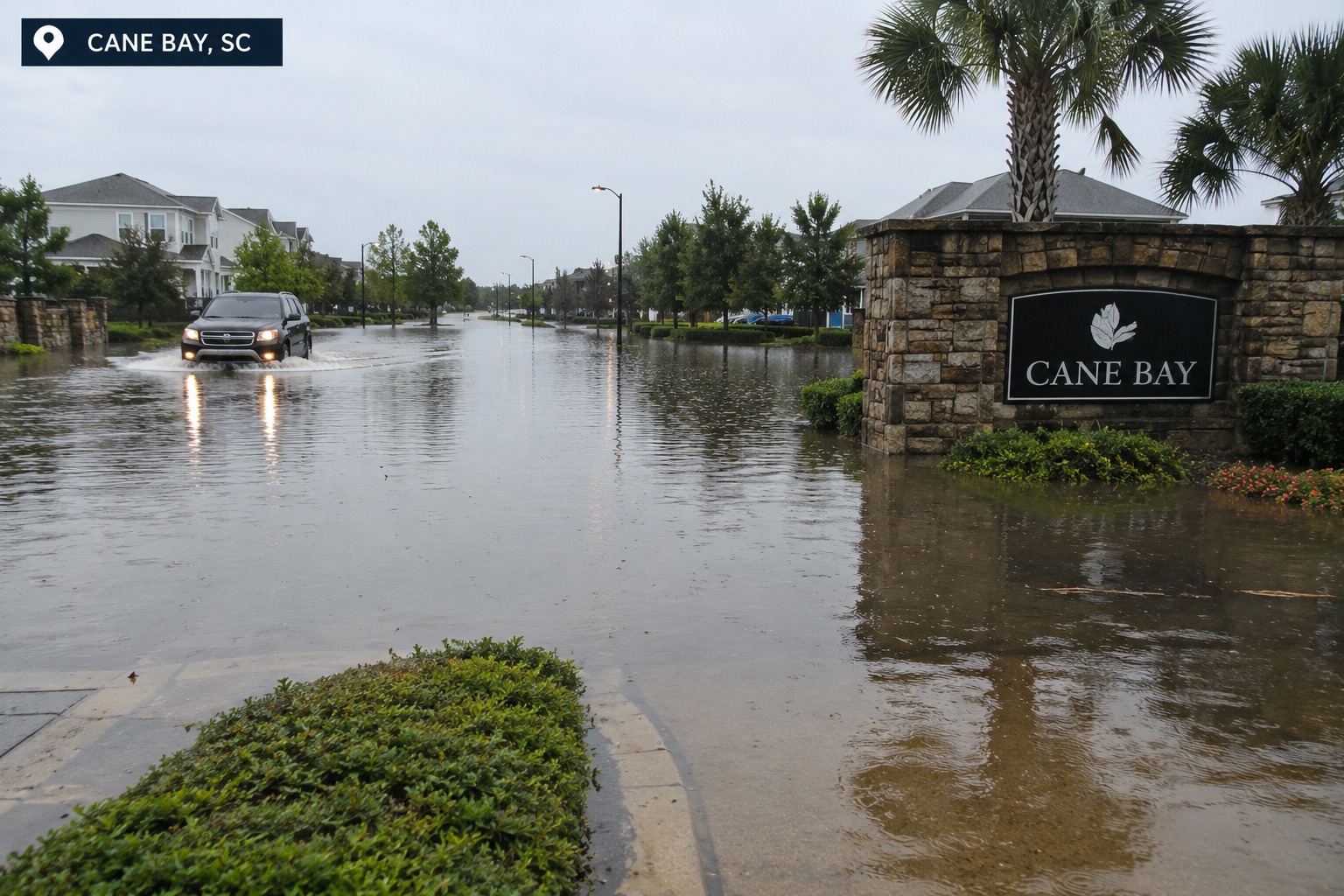
Stormwater Questions Continue Following Recent Flooding
Beyond traffic, stormwater management has become one of the most closely watched issues in Berkeley County development discussions.
Following repeated flooding events across portions of the rapidly growing Summerville and Cane Bay corridors, many residents have become increasingly skeptical that new subdivisions can adequately account for cumulative watershed impacts.
Several neighboring property owners have requested stronger long-term stormwater protections and legally binding assurances that runoff from future development will not negatively affect existing homes.
Developers maintain their engineering plans satisfy all county and state requirements.
Residents Seek Larger Buffers
Another point of disagreement involves the transition between existing rural neighborhoods and the proposed development.
Current plans include landscaped and wooded buffers separating Lake Village from surrounding communities.
However, several residents argue those buffers should be substantially wider.
Community members have requested:
- Larger protected wooded buffers
- Permanent restrictions preventing future road connections into existing neighborhoods
- Stronger stormwater guarantees
- Additional protections preserving the character of surrounding rural communities
Some residents remain unconvinced that today’s development commitments will remain unchanged decades into the future.
Campaign Contributions Draw Public Attention
As the project advances, several residents have also questioned campaign contributions made by companies associated with the developer to various elected officials.
According to publicly available campaign finance filings, multiple Berkeley County officials have received legal campaign contributions connected to businesses affiliated with the developer during previous election cycles.
County officials have publicly stated that those contributions will have no bearing on their votes.
They emphasize that campaign donations are disclosed under South Carolina ethics laws and do not obligate elected officials to support any specific project.
No evidence has been presented indicating any violations of campaign finance laws.
One Development, A Much Larger Debate
The Lake Village proposal reflects a much broader conversation taking place throughout Berkeley County.
Few dispute that the Charleston region continues to experience extraordinary population growth.
The larger question has become how that growth should occur.
Residents increasingly argue that infrastructure—including roads, schools, drainage systems and emergency services—should lead development rather than follow it.
Developers counter that new communities generate the tax base and impact fees necessary to fund future infrastructure improvements.
County leaders now find themselves balancing private property rights, housing demand, economic development and the concerns of residents who believe the pace of growth has already exceeded the area’s capacity.
As Berkeley County Council moves toward a final decision later this year, Lake Village is likely to become another defining chapter in the region’s ongoing debate over growth, infrastructure and the future of Cane Bay.
Leave a Reply