
By Jennifer Jordan | Charleston Housing News
A proposed 95-townhome subdivision on James Island has cleared its first major hurdle, but not without significant resistance from nearby residents who argue the project will worsen traffic, flooding and overall quality of life.
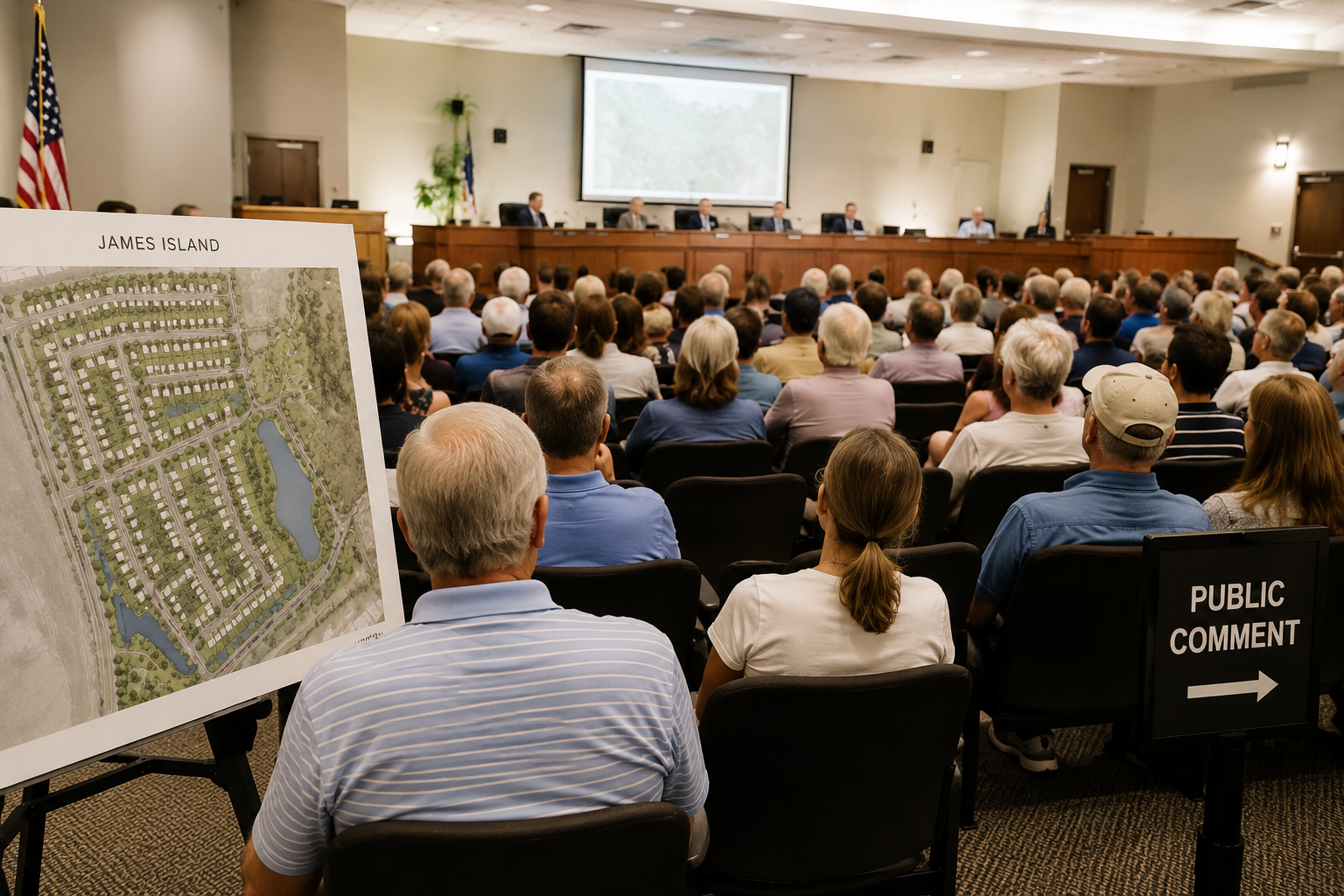
At its July 15 meeting, the Charleston Planning Commission unanimously granted conceptual approval for the proposed Riverland Oaks development, a 28-acre project planned behind Charleston Pour House near the intersection of Maybank Highway and Woodland Shores Road.
The vote came despite more than 130 written objections, dozens of residents attending the meeting in person and approximately 15 speakers urging commissioners to reject the proposal.
For many residents, the decision reinforces a growing frustration with Charleston’s development process: public opposition often carries far less weight than existing zoning regulations.
Commissioners Say Their Authority Is Limited
While many residents hoped the Planning Commission would reject the proposal, commissioners repeatedly emphasized that their role at this stage was narrowly defined.
Vice Chairman Harry Lesesne explained that the commission was not deciding whether the development itself was appropriate, but only whether the conceptual layout complied with existing city development standards.
Because the property has been zoned for Diverse Residential since the 1980s, city staff advised that the proposed density falls within the property’s existing legal entitlement.
That distinction frustrated many residents who believed the commission had greater discretion to stop the project.
In reality, much of the debate centered on a challenge common throughout fast-growing communities: once zoning has been established, reversing development rights becomes significantly more difficult.
Familiar Concerns Across the Charleston Region
Although this project is specific to James Island, the concerns raised by residents are familiar across much of the Charleston metropolitan area.
Traffic congestion, flooding, stormwater management, school capacity and infrastructure have become recurring issues as residential growth continues throughout Charleston County, Berkeley County and Dorchester County.
Residents speaking against Riverland Oaks argued that Maybank Highway already experiences substantial congestion during peak travel periods and questioned whether surrounding roads could safely accommodate additional vehicles generated by 95 new townhomes.
Flooding was another major concern.
James Island has experienced repeated drainage issues during heavy rainfall events, leading many nearby homeowners to question whether additional impervious surfaces could increase runoff despite proposed stormwater improvements.
Developer Says Project Will Improve Infrastructure
Representatives for Mount Pleasant engineering firm Sitecast LLC, which presented the concept plans, argued the development would provide infrastructure improvements rather than create additional problems.
According to project engineer Chris Donato, Riverland Oaks would include approximately seven acres of stormwater detention ponds designed to manage runoff while creating a new connection between Maybank Highway and Pawpaw Street that could help distribute local traffic more efficiently.
The development team also stated that only three of the site’s 42 existing trees would be removed during construction.
Those assurances, however, did little to ease concerns among many neighboring property owners.
The Larger Housing Challenge
Projects like Riverland Oaks illustrate one of Charleston’s most difficult balancing acts.
The region continues facing a housing shortage while simultaneously confronting growing public resistance to higher-density residential development.
Charleston needs additional housing to accommodate population growth and improve affordability, yet many proposed developments encounter strong neighborhood opposition because existing infrastructure often struggles to keep pace.
That tension has become increasingly common throughout the Lowcountry.
Communities want solutions to rising housing costs, but many residents oppose new projects when they believe roads, drainage systems and public services have already reached capacity.
Why Existing Zoning Matters
One of the biggest misconceptions surrounding development approvals is the role of zoning.
Many residents assume public opposition alone can prevent a project from moving forward.
In practice, once land has been properly zoned for residential development, local governments often have limited legal authority to deny projects that comply with adopted regulations.
That’s exactly what occurred during the Riverland Oaks hearing.
Commissioners repeatedly acknowledged residents’ concerns while also recognizing that the property owner possesses long-established development rights under the city’s zoning ordinance.
Future permitting, engineering reviews and additional approvals remain before construction could begin, but the conceptual approval represents an important milestone for the project.
What Comes Next
Riverland Oaks is still in the early stages of Charleston’s development review process.
Additional engineering plans, drainage studies and infrastructure reviews will occur before final approvals are considered.
For nearby residents, however, the July 15 vote demonstrates the importance of participating in zoning decisions long before individual developments reach the Planning Commission.
Once development rights have been established, local boards frequently have fewer options than many residents realize.
As Charleston continues growing, disputes like Riverland Oaks are likely to become increasingly common, highlighting the ongoing challenge of balancing housing demand with infrastructure capacity and neighborhood concerns.
Frequently Asked Questions
Where is the Riverland Oaks development proposed?
The project is planned behind Charleston Pour House near Maybank Highway and Woodland Shores Road on James Island.
How many homes are proposed?
The conceptual plan includes 95 townhomes on approximately 28 acres.
Why are residents opposing the project?
Most concerns focus on increased traffic, flooding, stormwater management and neighborhood infrastructure.
Why did the Planning Commission approve it?
Commissioners said the proposal met existing conceptual development standards and that the property’s zoning already permits residential development.
Can the project still change?
Yes. Additional engineering, permitting and technical reviews remain before final approvals.
Will the project include stormwater improvements?
Developers say approximately seven acres of detention ponds are planned to manage runoff.
Will roads be improved?
The applicant says the project would create a connection between Maybank Highway and Pawpaw Street intended to improve local traffic circulation.
Is Charleston seeing more neighborhood opposition to development?
Yes. Similar debates have become increasingly common as residential growth continues throughout the region.
Why can’t cities simply deny projects residents oppose?
If a proposal complies with existing zoning and development regulations, local governments often have limited legal authority to reject it.
What does this mean for Charleston’s housing market?
The debate reflects the growing tension between increasing housing supply and ensuring infrastructure keeps pace with continued population growth.
Leave a Reply