
By Jennifer Jordan | Charleston Housing News
As America celebrates its 250th anniversary, it’s worth reflecting on one of the principles that helped define our nation from the beginning: the belief that private property rights are fundamental to individual freedom. For generations, Americans have viewed homeownership as more than just an investment. It has represented independence, financial security, and the ability to determine how one’s own property is used.
That is what makes today’s short-term rental debate so frustrating.
Across the Charleston region, local governments are increasingly passing ordinances that tell homeowners what they can and cannot do with their own property. In North Charleston, permits are capped by council district. Other municipalities have adopted their own restrictions, occupancy limits, licensing requirements, inspections, and enforcement mechanisms. Whether one agrees with every regulation or not, there is no question that government involvement in private property has expanded dramatically.
The irony is that many of these regulations are not the original problem. They are the reaction to a problem created by companies whose business model has outpaced the ability of local communities to manage its consequences.
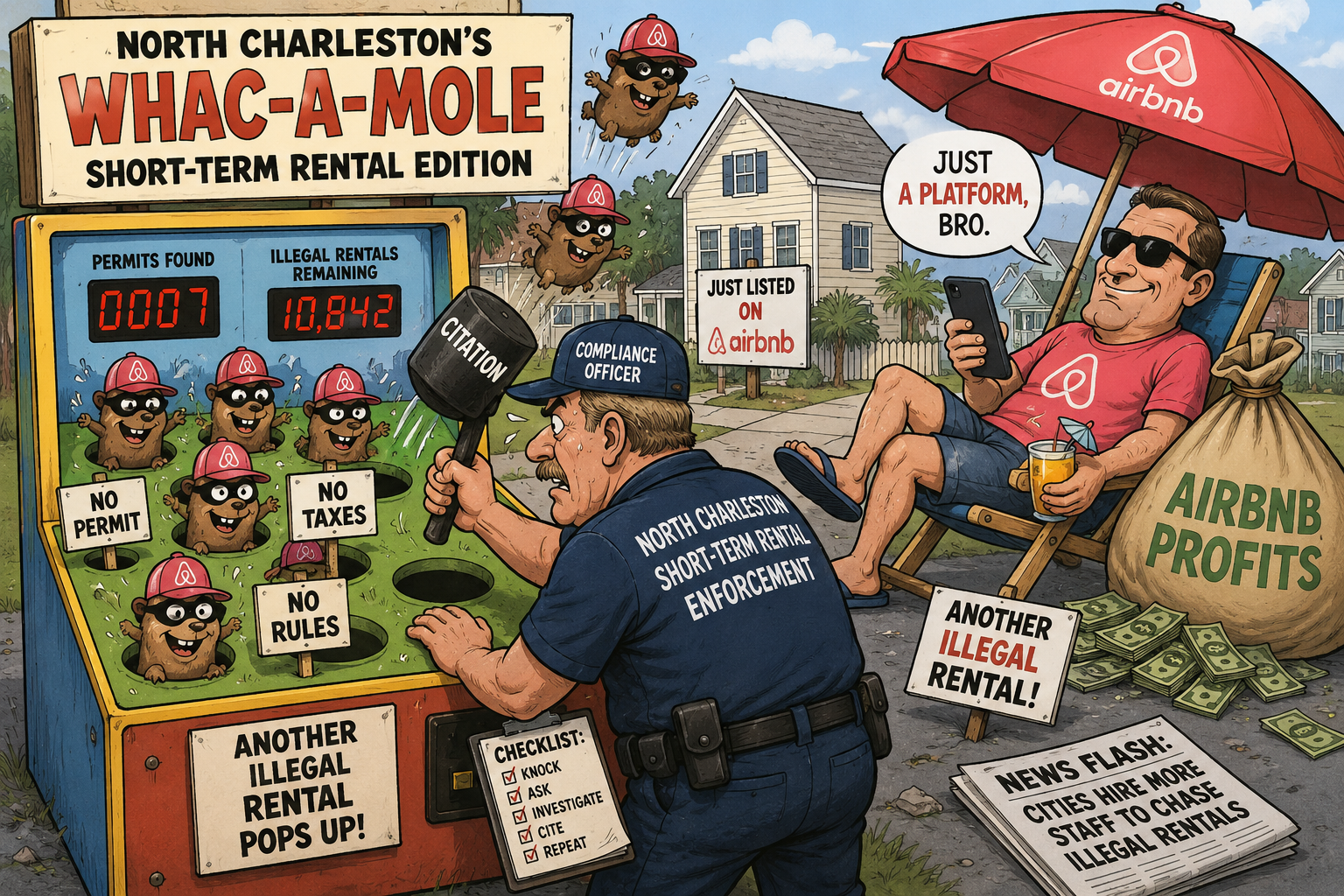
One of the best recent examples came from The Post and Courier, where reporter Kenna Coe examined North Charleston’s efforts to combat illegal short-term rentals. Her reporting follows Patrick Nathan, the city’s short-term rental compliance officer, whose full-time job has become identifying and citing illegal vacation rental operators. Nathan described his work as “a constant game of Whac-A-Mole,” a remarkably accurate description of the challenge facing cities across America. He later explained the city’s approach by saying, “Our goal is to solve the problem now. We’re not going to play this chase game.”
Those comments should raise a much bigger question than whether another homeowner receives a citation.
Why is North Charleston paying someone to chase illegal listings in the first place?
Airbnb is not a small startup operating out of someone’s garage. It is one of the largest technology companies in the world, generating billions of dollars in annual revenue by facilitating short-term rental transactions. The company knows where every property is located. It knows who owns it. It knows when reservations are made, how frequently a property is rented, and exactly how much money changes hands.
Yet in many communities, the responsibility for determining whether those properties comply with local law falls almost entirely on local governments after the listings have already gone live.
That is backwards.
If a contractor cannot legally perform work without a license, and a restaurant cannot legally operate without health inspections, why should a property be allowed to advertise nightly rentals in a jurisdiction that requires permits without first demonstrating that it complies with local law?
The technology to verify permits already exists. Airbnb already verifies payment information, identities, reviews, and countless other pieces of data. Requiring a valid permit number before accepting bookings in municipalities where permits are required would hardly be an impossible task. Instead, local governments spend taxpayer dollars hiring compliance officers, conducting investigations, issuing citations, and prosecuting violations while the platform continues collecting booking fees.
From my perspective, that represents one of the most irresponsible aspects of Airbnb’s business model. The profits remain private while much of the cost of enforcement becomes public.
Charleston’s housing market has paid another price as well.
To be fair, Airbnb did not single-handedly create today’s housing affordability crisis. Charleston’s remarkable population growth, limited developable land, rising construction costs, insurance premiums, labor shortages, restrictive zoning, and higher mortgage rates have all contributed to increasing home prices. Anyone who claims there is a single cause for housing affordability is oversimplifying an extraordinarily complex issue.
However, it would be equally misleading to pretend that short-term rentals have had little impact.
Every home that is permanently converted from long-term housing into a full-time vacation rental removes another opportunity for a local family, teacher, nurse, firefighter, Boeing employee, hospitality worker, or young professional to purchase or rent housing near where they work. In a market where inventory has already struggled to keep pace with population growth, removing thousands of homes from the long-term housing supply inevitably affects availability and pricing.
That reality has forced cities into a position many probably never anticipated. Local officials are attempting to preserve neighborhoods while simultaneously protecting property rights, encouraging tourism, supporting local businesses, and responding to residents frustrated by constant turnover in what were once stable residential communities.
This is where the debate becomes more nuanced than either side often acknowledges.
As someone who strongly believes in private property rights, I am uncomfortable with governments dictating how law-abiding homeowners use their own property. That discomfort is amplified during a year in which our country celebrates 250 years since declaring that government exists to protect—not unnecessarily restrict—the freedoms of its citizens.
At the same time, neighborhoods also have legitimate interests. Few people purchase a home expecting the house next door to function as an unregulated hotel with a revolving door of weekend guests, bachelor parties, parking problems, and late-night activity. Residents have every right to expect that local governments will preserve the character of the communities they invested in.
The question, then, is whether local governments are being forced into increasingly restrictive regulations because Airbnb has failed to accept a greater share of responsibility for the marketplace it created.
I believe the answer is yes.
Rather than acting as an active partner with municipalities, Airbnb has largely left cities to identify illegal operators one property at a time. North Charleston’s compliance officer is literally driving neighborhoods searching for out-of-state license plates and knocking on doors to determine whether a rental is operating legally. That may be dedicated public service, but it is hardly an efficient regulatory system in the age of sophisticated technology.
The larger concern extends beyond Charleston.
Across the country, communities are increasingly wrestling with how to balance tourism, housing affordability, neighborhood preservation, and private property rights. Many investors entered the short-term rental market believing vacation rentals would provide endless appreciation and dependable cash flow. In some markets they have. In others, tightening regulations, permit caps, and changing economic conditions have begun reshaping those assumptions.
Like every investment strategy, short-term rentals carry risk. Regulations change. Market conditions evolve. Tourism fluctuates. Investors who built financial projections assuming unrestricted operations forever may eventually discover that public policy can be just as influential as occupancy rates.
Charleston remains one of America’s great destinations, and tourism will always play an important role in our local economy. Responsible short-term rental owners who follow the rules, pay taxes, obtain permits, and respect their neighbors should absolutely have a place in that economy. They are not the problem.
The problem is a business model that has often allowed illegal operators to flourish while local taxpayers finance the enforcement necessary to find them.
As we celebrate America’s 250th birthday, perhaps the larger conversation should not simply be about whether cities should regulate homeowners more aggressively. Perhaps it should be about whether one of Silicon Valley’s largest technology companies should finally accept greater responsibility for the marketplace it created.
Freedom and responsibility have always gone hand in hand. If Airbnb wants to continue profiting from communities like Charleston, it should be expected to shoulder far more of the responsibility for protecting them than it does today.
Leave a Reply