
By Jennifer Jordan | Charleston Housing News
If you’ve been waiting for Charleston home prices to fall because mortgage rates remain stubbornly high, you may be waiting longer than expected.
National headlines increasingly suggest that elevated borrowing costs should put downward pressure on housing values. The logic seems straightforward: if fewer people can afford homes, prices should fall.
In Charleston, however, the story isn’t quite that simple.
Mortgage rates have hovered around 6.5 percent for much of 2026. At the same time, active inventory across the Charleston region has climbed above 5,500 homes — levels the market hasn’t experienced in years. More than 200 properties have been withdrawn from the market since the end of May alone as sellers struggle to adapt to shifting conditions.
Yet despite these headwinds, Charleston has not experienced the dramatic price corrections some buyers have been anticipating.
The reason lies in the unique dynamics of the Lowcountry housing market.
Charleston Isn’t One Market
A condominium in downtown Charleston, a starter home in Goose Creek, a deepwater property on Isle of Palms, and an equestrian estate in Hollywood are all affected differently by higher mortgage rates.
Many luxury buyers continue to purchase with cash or substantial equity.
Move-up buyers often bring hundreds of thousands of dollars in proceeds from prior home sales.
At the same time, first-time buyers face mounting affordability pressures as higher interest rates, insurance premiums, HOA fees, and student loan obligations strain household budgets.
The result is a market moving at different speeds depending on price point and location.
The Buyers Are Still Here
Contrary to popular belief, Charleston doesn’t have a demand problem.
It has an affordability problem.
“Charleston continues to attract buyers because people genuinely want to live here,” said Bryan Crabtree, broker associate with Indigo Oak Christie’s International Real Estate. “What we’re seeing isn’t a disappearance of demand. It’s buyers becoming much more selective because affordability has become the dominant factor.”
According to the Federal Reserve Bank of St. Louis, mortgage denial rates climbed from 12.2 percent in 2021 to 15.1 percent in 2024. Debt-to-income ratios accounted for 35 percent of those denials.
“People assume buyers are sitting on the sidelines waiting for rates to drop,” Crabtree said. “Many are actually discovering they no longer qualify for the homes they expected to buy. That’s a very different dynamic.”
Inventory Is Rising, But Not Equally
While Charleston inventory has expanded significantly from pandemic-era lows, supply remains uneven.
Certain segments of the market have become increasingly competitive among sellers.
Homes that entered the market priced aggressively based on 2021 and 2022 expectations often sit longer, undergo price reductions, or are withdrawn altogether.
Meanwhile, well-priced properties in desirable neighborhoods continue attracting substantial interest.
“Buyers today have choices,” Crabtree said. “That means presentation, pricing, condition, and strategy matter more than they have in years.”
Don’t Expect a 2008 Repeat
The natural question becomes whether Charleston is headed toward a broader correction if rates remain elevated through the end of the year.
History suggests caution.
Unlike the housing crash of the late 2000s, today’s market isn’t characterized by widespread subprime lending, speculative construction, or fundamentally weak underwriting standards.
Instead, buyers face the opposite problem.
They’re being held to increasingly stringent affordability requirements.
Crabtree, who was Charleston’s top individual listing agent for three consecutive years during the housing downturn, says the comparison has limits.
“The fear feels similar, but the fundamentals are completely different,” he said. “During the crash, the market was flooded with distressed inventory. Today, the challenge is that buyers are being constrained by monthly payments and qualification standards.”
What Happens Next?
If mortgage rates remain elevated through the remainder of 2026, Charleston may continue experiencing what economists describe as a market normalization.
Price appreciation is likely to remain muted.
Certain neighborhoods and price points may experience modest declines.
Sellers may need to adjust expectations.
But broad-based price collapses remain unlikely absent a significant economic disruption.
Conversely, should mortgage rates decline meaningfully, Charleston’s persistent demand could quickly absorb available inventory.
“We’ve built up a tremendous amount of pent-up demand,” Crabtree said. “If rates moved back into the fives, I think you’d see activity accelerate quickly because many buyers have simply been waiting for an opportunity to make the numbers work.”
The Charleston Reality
The truth is that Charleston has always played by slightly different rules.
People continue relocating here for the coastline, the lifestyle, the schools, the climate, and the region’s expanding economy.
Those factors provide resilience that many other markets lack.
That doesn’t mean sellers can ignore market conditions.
It doesn’t mean buyers should abandon caution.
It simply means that in Charleston, higher mortgage rates don’t automatically translate into falling home prices.
At least not in the way many people expect.
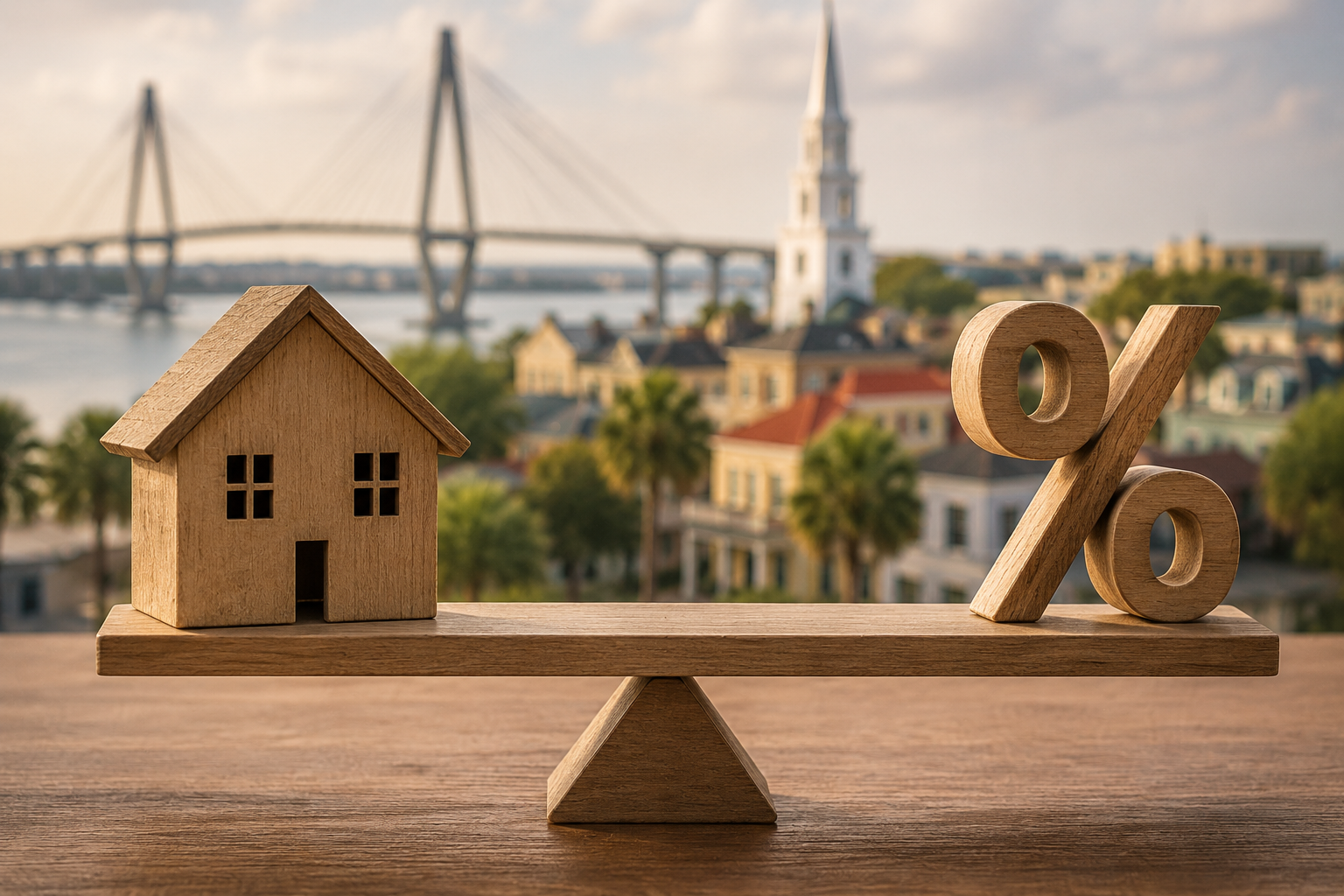
Instead, the Lowcountry housing market appears to be entering a new phase — one defined not by panic or exuberance, but by balance.
And after several years of extremes, that may be exactly what Charleston needs.
Leave a Reply