
By Jennifer Jordan | Charleston Housing News
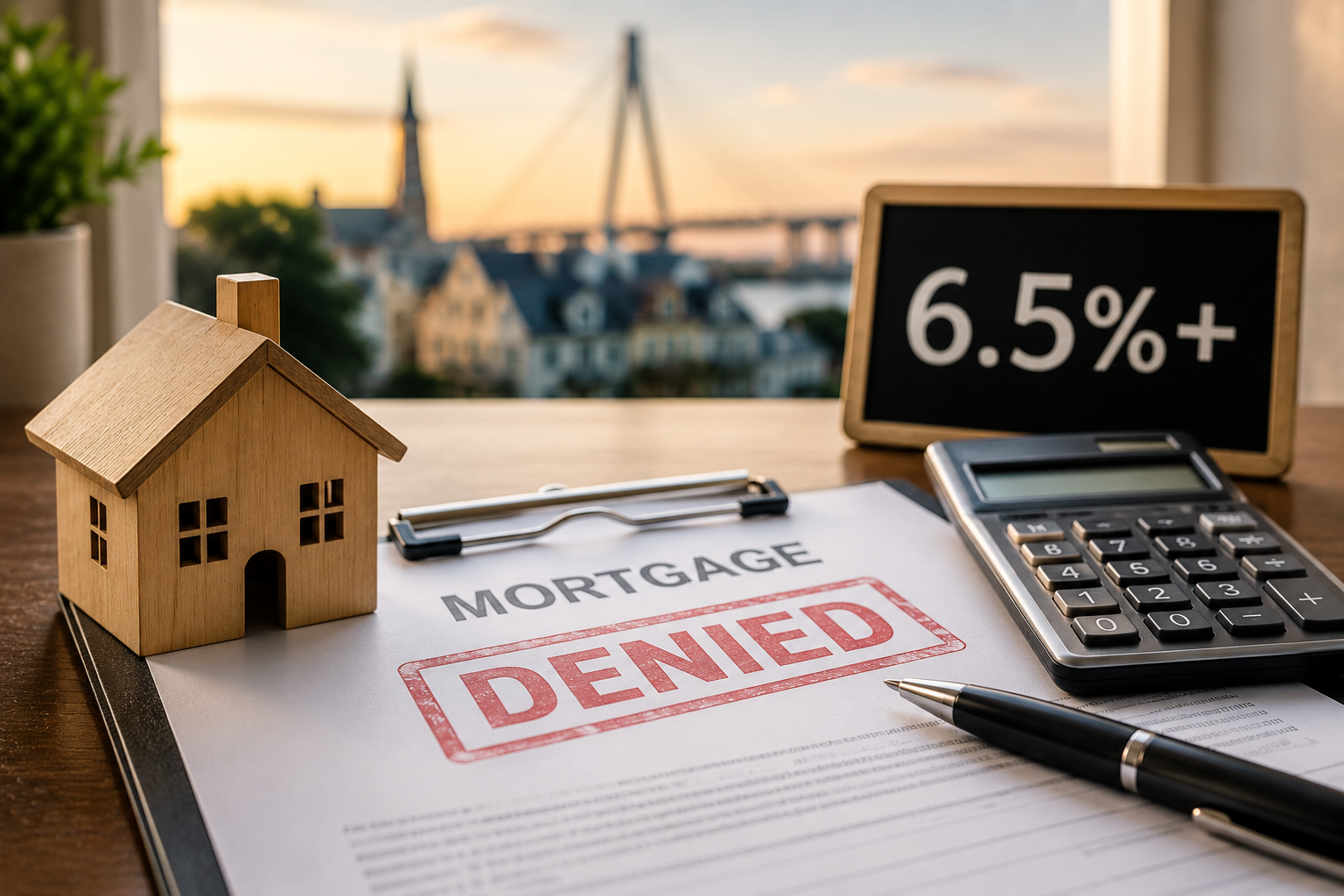
As mortgage rates remain stubbornly above 6.5 percent, Charleston’s housing market is facing a challenge that extends well beyond buyer psychology.
The issue isn’t simply that higher rates discourage people from purchasing homes.
Increasingly, higher rates are preventing otherwise qualified buyers from obtaining financing altogether.
New research from the Federal Reserve Bank of St. Louis found that mortgage denial rates climbed to 15.1 percent in 2024, up from 12.2 percent in 2021. The increase coincided with mortgage rates rising from below 3.5 percent during the pandemic housing boom to levels exceeding 6.5 percent today.
While many assume elevated rates simply reduce demand, economists say the reality is more complicated.
As rates rise, monthly mortgage payments increase. Those higher payments push borrowers’ debt-to-income ratios upward. Once those ratios exceed lender guidelines, loan approvals become increasingly difficult — even for applicants with excellent credit histories.
According to the St. Louis Fed, debt-to-income ratios accounted for 35 percent of all mortgage denials in 2024.
That distinction matters in Charleston.
The Lowcountry continues attracting new residents drawn by its quality of life, coastline, employment opportunities and vibrant communities. Yet affordability pressures have mounted significantly over the past several years as home prices, insurance costs, property taxes and borrowing costs have all moved higher.
The result is a market that still has buyers — but fewer buyers who can actually qualify.
“Buyers today aren’t disappearing because they don’t want to buy,” said Bryan Crabtree, broker associate with IndigoOak Christie’s International Real Estate. “Many are being squeezed out by basic math. We’re seeing people with stable jobs, strong credit and meaningful savings discover that higher rates push them just beyond what lenders will approve.”
Crabtree, who was Charleston’s top individual listing agent for three consecutive years during the housing downturn of the late 2000s (and one of Charleston’s top luxury agents today), says the market conditions today are fundamentally different from the Great Recession, but the emotional response from consumers is familiar.
“During the crash, people were afraid because of collapsing values and uncertainty about the financial system,” Crabtree said. “Today’s buyers are afraid they’ll miss their opportunity entirely because the monthly payment no longer works. The demand is still there. The qualification isn’t.”
That distinction may help explain what many Charleston agents are witnessing firsthand.
Open houses continue attracting visitors.
Online listing activity remains healthy.
Showings still occur.
But contracts aren’t materializing at the same pace because financing approval has become a more significant hurdle.
“It’s creating a tremendous amount of pent-up demand,” Crabtree said. “Many buyers are simply waiting for either rates to improve, their incomes to increase, or for the right opportunity to fit within the realities of today’s lending environment.”
The trend carries implications for sellers as well.
During the frenzied seller’s market of recent years, homeowners could often rely on limited inventory to overcome pricing mistakes, deferred maintenance or less-than-stellar presentation. Today’s market is less forgiving.
“When buyers have fewer dollars to work with, they become more selective,” Crabtree said. “They’re scrutinizing monthly payments, insurance costs, HOA fees and overall value much more carefully. Sellers who understand that reality and price accordingly are still succeeding. Those who chase yesterday’s market are finding the process much more challenging.”
Nationally, the median price of an existing home stood at $417,700 in April, according to the National Association of Realtors. Although annual appreciation has moderated, home values remain substantially higher than they were just five years ago.
Meanwhile, many younger buyers continue carrying student loan obligations that further impact debt-to-income calculations.
The result is what economists increasingly describe as an affordability crisis rather than a demand crisis.
Charleston remains one of the nation’s most desirable housing markets. Population growth continues. Employers continue relocating to the region. Residents continue moving to the area in search of the Lowcountry lifestyle.
But as mortgage rates remain elevated, affordability pressures may continue limiting how many households can successfully transition from aspiring buyers to actual homeowners.
The good news is that demand hasn’t vanished.
The bad news is that for many buyers, qualifying for the home they want has become substantially more difficult.
And until that equation changes, Charleston’s housing market may continue operating under a new reality — one where many buyers aren’t choosing to stay on the sidelines.
They’re being pushed there.
Leave a Reply