
By Jennifer Jordan
The Charleston region’s real estate market continues attracting national capital at a remarkable pace.
But increasingly, it’s not just luxury homebuyers or individual investors pouring money into the Lowcountry.
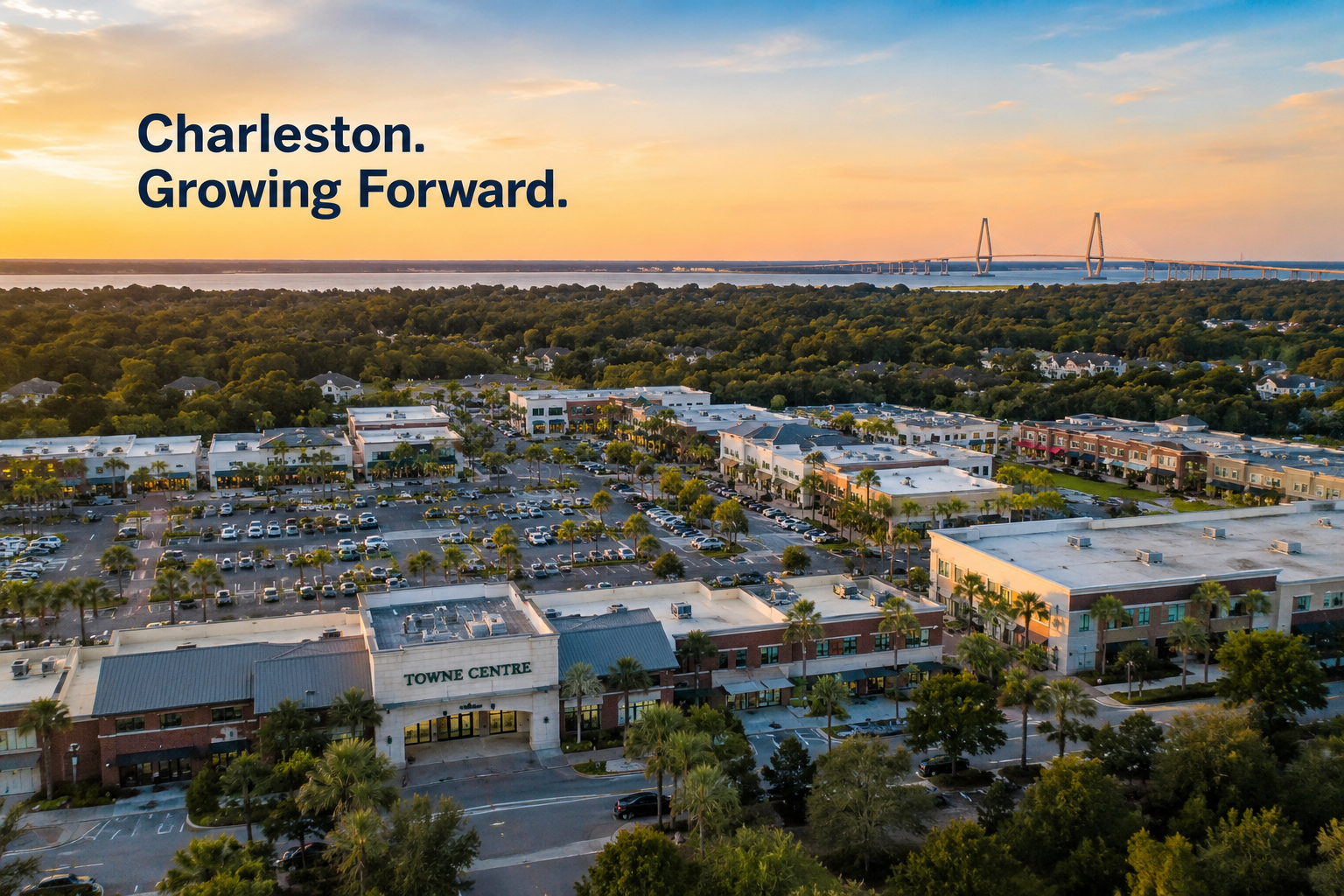
Institutional real estate firms are aggressively expanding their footprint across the Charleston metro—and the latest acquisition involving the owner of Mount Pleasant Towne Centre highlights how deeply major investors still believe in the long-term future of the region.
Maryland-based Continental Realty Corp., which already owns several major Charleston-area commercial and multifamily properties, recently expanded its portfolio as part of a roughly $200 million multi-state retail acquisition.
The move may appear on the surface to be a retail story.
But underneath it is something much larger:
- A long-term bet on Charleston’s population growth
- Confidence in the region’s housing expansion
- And continued institutional belief that the Charleston metro remains one of the strongest growth markets in the Southeast
Charleston’s Housing Growth Is Fueling Everything Else
Retail follows rooftops.
And Charleston’s housing growth over the last decade has fundamentally reshaped where institutional money is flowing.
Communities including:
- Mount Pleasant
- Summerville
- Daniel Island
- Johns Island
have all experienced enormous residential expansion.
That residential growth creates the conditions institutional investors want most:
- Consistent consumer traffic
- Strong household formation
- Long-term population migration
- Stable retail demand
- Multifamily absorption potential
Continental Realty’s Charleston-area holdings now span both retail and residential assets, giving the company exposure to multiple layers of the region’s growth story.
The Nexton and Summerville Story Continues Expanding
One of the more telling aspects of the company’s Charleston presence is its growing investment near Nexton and the broader Summerville corridor.
The firm recently acquired a multifamily community within Nexton—one of the largest master-planned developments in South Carolina.
That’s important because Summerville has become one of the defining housing stories of the modern Charleston market.
As affordability pressures pushed buyers farther from downtown Charleston and Mount Pleasant over the past decade, areas like:
- Cane Bay
- Nexton
- Goose Creek
- Berkeley County
became the new center of suburban expansion.
Developers responded with:
- Large master-planned communities
- Mixed-use retail centers
- Apartment developments
- Lifestyle-oriented suburban infrastructure
Institutional investors are now following that same migration pattern.
Why National Investors Still Like Charleston
Despite higher mortgage rates and signs of slowing transaction volume in portions of the housing market, Charleston continues attracting significant outside investment capital.
Why?
Because the region still offers something many large investors prioritize:
- Population growth
- Lifestyle migration
- Limited coastal land supply
- Strong long-term demographics
- Relative economic diversification
Even as some Sunbelt markets begin experiencing oversupply concerns, Charleston remains comparatively supply-constrained—especially near core coastal corridors.
That supply limitation continues supporting both:
- Housing demand
- Retail occupancy performance
And institutional investors notice that.
Johns Island Is Becoming the Next Major Growth Frontier
The article’s reference to the continued expansion of Kiawah River highlights another important trend in Charleston housing.
Johns Island is increasingly transitioning from a secondary suburban market into one of the region’s premier long-term development corridors.
Projects like Kiawah River represent a newer type of Charleston-area development:
- Lifestyle-focused
- Conservation-oriented
- Mixed-use
- Experience-driven
Rather than simply building subdivisions, developers are increasingly creating entire ecosystems centered around:
- Agriculture
- Wellness
- Outdoor recreation
- Hospitality
- Walkability
That evolution reflects changing buyer preferences—especially among affluent relocators moving into the Charleston market.
The Institutionalization of Charleston Real Estate
Perhaps the biggest story underneath all of this is the continued institutionalization of Charleston real estate itself.
A decade ago, much of Charleston’s growth was still heavily driven by:
- Local developers
- Regional builders
- Smaller ownership groups
Today, national firms increasingly dominate:
- Multifamily ownership
- Retail centers
- Large mixed-use developments
- Build-to-rent communities
- Industrial development
That shift changes the market in meaningful ways.
Large institutional firms often:
- Hold assets longer
- Operate at larger scale
- Influence rental pricing trends
- Shape future development patterns
And Charleston is now firmly on the radar of those investors.
What It Means for Charleston Housing Going Forward
The continued inflow of institutional capital suggests one thing clearly:
Large investors still believe Charleston’s long-term growth story remains intact.
Even as:
- Mortgage rates stay elevated
- Affordability pressures increase
- Housing activity normalizes
…the region continues attracting billions in combined residential, retail, multifamily, and infrastructure investment.
That doesn’t mean the market is immune from slowing.
But it does reinforce a broader reality:
Charleston has evolved into a nationally recognized growth market—and major investors are positioning themselves accordingly.
Leave a Reply