
By Jennifer Jordan | Charleston Housing News
South Carolina continues to rank as one of the fastest-growing states in the country—but if you live in Charleston, you don’t need Census data to tell you that. You feel it every day in traffic, home prices, and the pace of development.
New population estimates show that while South Carolina’s growth remains among the strongest in the nation, the rate of that growth is beginning to slow. That might sound like relief—but in reality, it’s not slowing enough in the places where it matters most.
And Charleston sits right at the center of that pressure.
Charleston Is Ground Zero for Growth
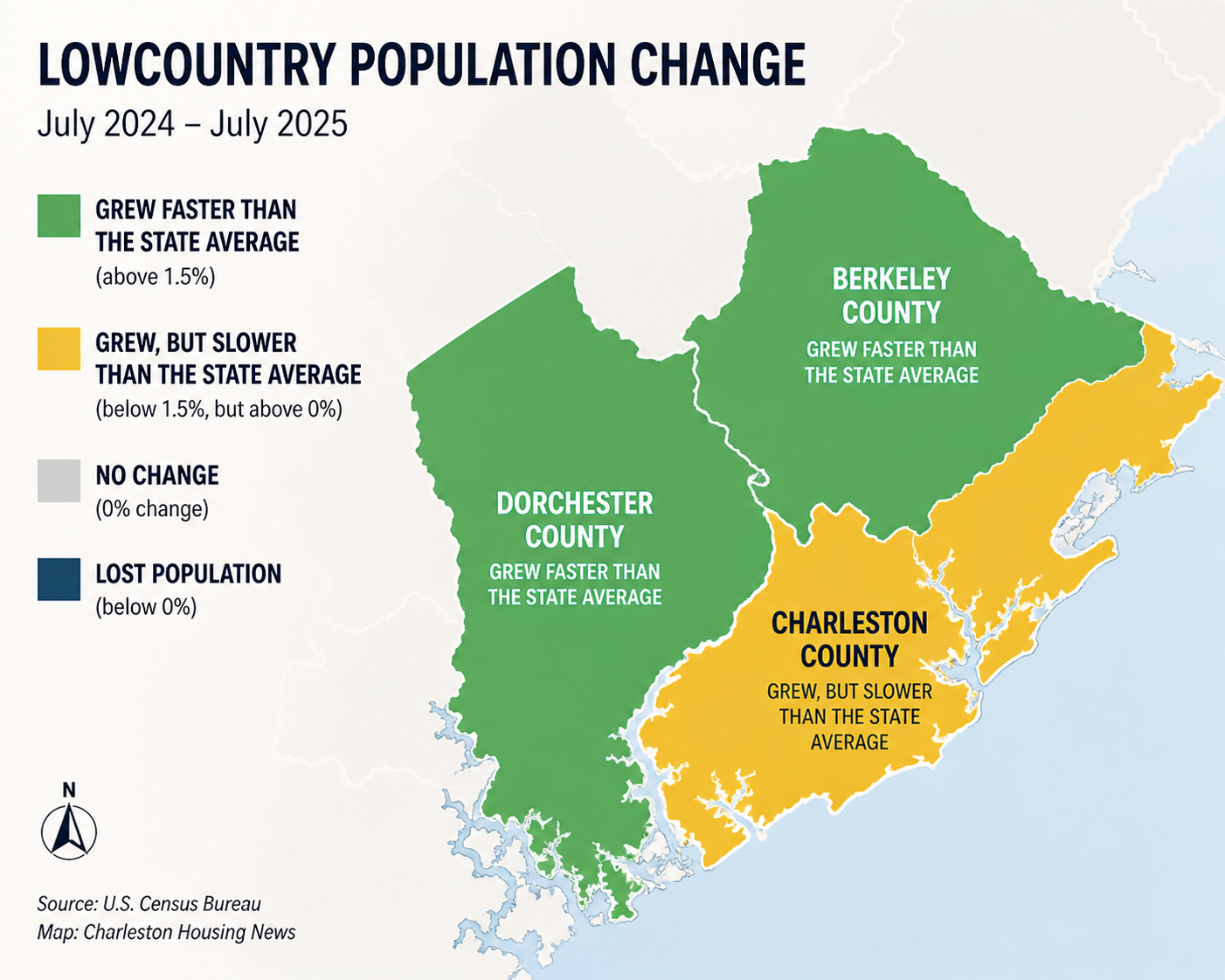
More than 80% of South Carolina’s population increase since 2020 has been concentrated in just ten counties—including Charleston County and neighboring Berkeley County.
That concentration explains why areas like Clements Ferry Road, Cainhoy, Wando, and the outskirts of Mount Pleasant are seeing explosive development.
Berkeley County alone grew by more than 3% in a single year—one of the fastest rates in the state—largely because buyers are being priced out of Charleston County and moving outward for affordability.
This isn’t random growth. It’s migration with a pattern:
- Buyers want proximity to Charleston
- They need more space and lower prices
- They’re willing to trade commute time to get it
The Charleston Trade-Off: Lifestyle vs. Infrastructure
Charleston’s growth has created a familiar equation:
✔️ Strong demand
✔️ Rising home values
❌ Increasing strain on infrastructure
Roads like Highway 41, Clements Ferry, and I-526 are already struggling to keep up. Schools, healthcare access, and basic services are being stretched as population density rises faster than planning can accommodate.
Statewide, officials acknowledge there’s no “silver bullet” solution.
In Charleston, that reality is even more pronounced.
Why Growth Feels Faster Than the Data Suggests
Interestingly, South Carolina’s growth rate actually slowed in 2025—even while remaining one of the fastest-growing states overall.
That contradiction comes down to two key shifts:
- Fewer people are moving between states compared to the pandemic surge
- International migration has also declined
But here’s the important part for Charleston:
Even with slower growth, demand is still overwhelming supply in key submarkets.
That’s why:
- Inventory remains tight in desirable areas
- Prices have held firm in many segments
- Outer corridors continue expanding rapidly
Who Is Moving to Charleston—and Why It Matters
Much of South Carolina’s growth is driven by out-of-state buyers, many of them retirees or remote workers.
That has ripple effects:
- Increased demand for healthcare and services
- Lower relative tax contributions due to retiree exemptions
- Higher competition for housing
Charleston, in particular, attracts:
- Lifestyle buyers (water, weather, culture)
- Wealth migration from higher-cost states
- Second-home and investment buyers
That combination pushes pricing pressure higher than the statewide average.
The Next Phase: Expansion Beyond Charleston Proper
As Charleston becomes more expensive and crowded, growth is radiating outward.
We’re seeing major expansion in:
- Berkeley County (Clements Ferry, Cainhoy, Moncks Corner)
- Dorchester County (Summerville and beyond)
- Peripheral areas feeding into Charleston’s job base
This is the same pattern seen in cities like Charlotte and Atlanta—but Charleston is earlier in that cycle.
And that’s where opportunity—and risk—both exist.
What This Means for Buyers and Sellers Right Now
For buyers:
- Waiting for a “crash” may not align with local reality
- Value is increasingly found in emerging submarkets
- Commute and infrastructure planning matter more than ever
For sellers:
- Demand is still strong—but more selective
- Pricing strategy is becoming critical in a shifting market
- Presentation and marketing are separating winners from stale listings
The Bottom Line
South Carolina is still growing—but that growth is uneven, concentrated, and increasingly complex.
Charleston isn’t just participating in that growth—it’s absorbing the pressure from it.
And while the pace may be slowing on paper, on the ground it still feels like acceleration.
Because in Charleston, it is.
Leave a Reply