
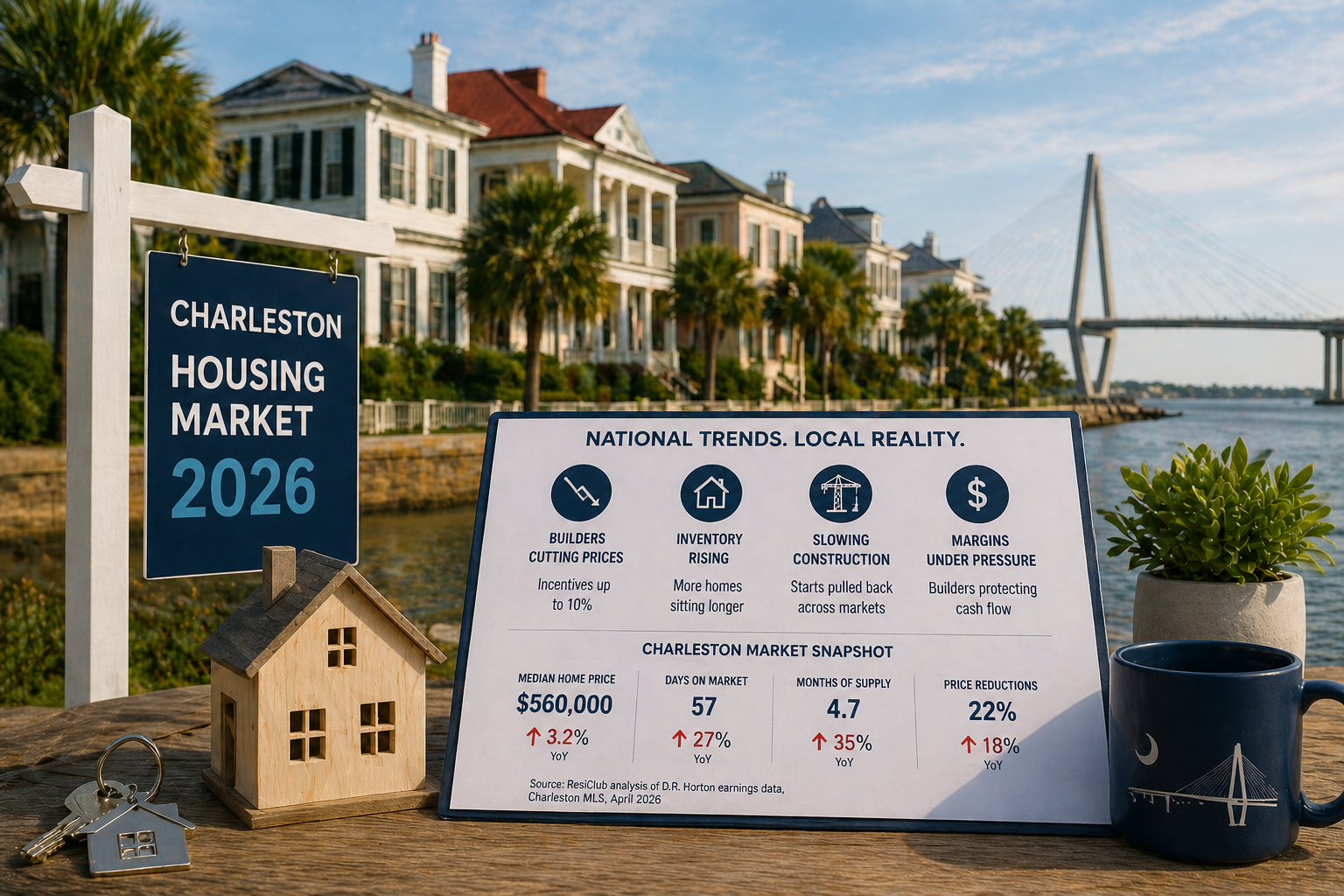
by Jennifer Jordan | Charleston Housing News
The national housing market is sending a clear signal—and if you’re watching closely in Charleston, it should get your attention.
America’s largest homebuilder, D.R. Horton, just revealed something that cuts through all the noise:
they are discounting homes, increasing incentives, and slowing new construction to manage a softer market.
That’s not theory. That’s reality.
And while much of the country is adjusting…
Charleston is lagging behind—and that could create a much sharper correction locally.
THE NATIONAL SIGNAL: BUILDERS ARE FEELING PRESSURE
Here’s what the latest data tells us:
- Unsold completed homes surged post-pandemic, peaking at 8,400 units
- Builders have reduced that to about 5,500 homes through aggressive adjustments
- Incentives have jumped to roughly 10% of revenue—well above normal levels
- Construction starts are being pulled back intentionally
Why does that matter?
Because builders don’t do this unless they have to.
They are:
- Cutting margins
- Buying down mortgage rates
- Offering closing cost incentives
- Slowing production
All to keep homes moving in a market where demand has cooled.
CHARLESTON: STILL HOLDING THE LINE—FOR NOW
Now bring that lens to Charleston.
Across Mount Pleasant, Summerville, Nexton, Cane Bay, and Johns Island, you’re seeing a very different dynamic:
- Builders are selectively offering incentives—but not broadly advertising them
- Many resale sellers are still pricing like it’s 2022
- Inventory is rising—but not yet forcing widespread price cuts
- Buyer activity is more cautious, more selective, and slower to act
In short:
The adjustment is happening—but it’s happening quietly.
THE BUILDER STRATEGY IS ALREADY HERE (JUST UNDER THE SURFACE)
If you look closely in Charleston’s new construction communities:
- Rate buydowns are being used to “hide” price reductions
- Design center upgrades are being thrown in to move spec homes
- Spec inventory is being managed more tightly than in prior years
This mirrors exactly what’s happening nationally.
But here’s the difference:
👉 In markets like Florida and Texas, the correction already hit hard
👉 In Charleston, pricing has remained more “sticky”
That creates risk.
WHY CHARLESTON COULD BE MORE VULNERABLE THAN IT LOOKS
Charleston has unique pressure points:
1. Affordability is already stretched
Home prices relative to income are among the most strained in the Southeast.
2. Insurance + taxes are rising
Carrying costs are increasing—even if purchase prices hold.
3. Migration demand is normalizing
The pandemic surge of inbound buyers is slowing.
4. Luxury inventory is building quietly
High-end listings—especially in Isle of Palms, Daniel Island, and Mount Pleasant—are sitting longer.
THE REAL RISK: A DELAYED ADJUSTMENT
Here’s where things get serious.
Builders across the country are already doing the hard work:
- Cutting deals
- Managing inventory
- Adjusting expectations
But in Charleston?
Many sellers haven’t adjusted yet.
That creates a gap between:
- What buyers are willing to pay
- What sellers expect to get
And when that gap widens too far…
The market doesn’t gradually correct—it snaps into alignment.
WHAT HAPPENS NEXT IN CHARLESTON
Based on both national trends and local behavior, here’s what to watch:
Short Term (Next 3–6 Months)
- More hidden incentives from builders
- Longer days on market
- Increased negotiation on resale homes
Mid Term (6–12 Months)
- Price reductions in overvalued segments
- Greater divide between updated vs outdated homes
- More visible inventory buildup
Luxury Market
- Continued softness unless pricing adjusts
- Fewer impulse buyers at higher price points
BOTTOM LINE
The national housing market is already adjusting—and builders are leading the charge.
Charleston is not immune.
In fact, because pricing has held higher for longer, the Lowcountry may be setting up for a more delayed—but sharper—market shift.
The takeaway is simple:
👉 The deals are already happening—you just have to know where to look
👉 The pricing reality is changing—even if it hasn’t fully shown up yet
👉 And the longer Charleston resists the shift…
the more significant that adjustment is likely to be when it arrives.
Leave a Reply